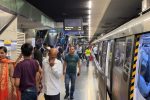

New Delhi witnessed heightened security on Friday as authorities tightened restrictions around central Delhi ahead of protests planned at Jantar Mantar. The Delhi Metro Rail Corporation closed entry and exit facilities at 12 stations, affecting some of the busiest areas of the capital and creating additional travel challenges for commuters.
The restrictions came after the Aam Aadmi Party and several student organisations announced demonstrations linked to concerns over the revision of electoral rolls and the Special Intensive Revision, or SIR, exercise. Protesters are demanding the resignation of Chief Election Commissioner Gyanesh Kumar, while authorities have increased security around Jantar Mantar and other sensitive locations.
According to the reported DMRC advisory, entry and exit were closed at Janpath, Patel Chowk, Central Secretariat, Rajiv Chowk, Barakhamba, Seva Teerth, Mandi House, Lok Kalyan Marg, INA, Chawri Bazar, Ramakrishna Ashram Marg and New Delhi stations. The restrictions were announced to remain in place until further notice.
For commuters, however, the Metro network has not completely stopped functioning at these locations. Interchange facilities remain available at key stations including Rajiv Chowk, Mandi House, New Delhi and Central Secretariat, allowing passengers to change lines even though normal entry and exit access is restricted.
The protest call has brought together the AAP, All India Students’ Association, National Students’ Union of India and Indian Youth Congress. Their demonstrations are connected to objections surrounding the electoral-roll revision process and the functioning of the Election Commission. These groups have called for action against Chief Election Commissioner Gyanesh Kumar, citing alleged irregularities in the electoral-roll revision exercise.
Delhi Police has said permission was not granted for the proposed gathering at Jantar Mantar. Security personnel and Central Armed Police Forces have been deployed in and around the area, while barricades have been installed on roads leading toward the protest location to regulate movement and prevent unauthorised gatherings.
The restrictions have also affected ordinary people simply trying to get through the heart of Delhi. Office workers, shoppers, visitors and other commuters using central Delhi routes have had to reconsider their travel plans, particularly around Jantar Mantar, Connaught Place, Parliament Street and nearby government districts.
AAP Delhi president Saurabh Bharadwaj has questioned the decision to deny permission for the demonstration, arguing that Jantar Mantar is a designated location for protests. His comments reflect the wider disagreement between the organisers and authorities over how the proposed demonstration should be handled.
The situation also comes as Delhi is observing Gandhi Jayanti, with separate security and traffic arrangements around Rajghat and Vijay Ghat. The combination of scheduled programmes, the protest call and additional police deployment has contributed to tighter movement controls across parts of central Delhi.
As the day unfolded, reports also emerged of protesters being detained as police attempted to prevent the gathering from developing at Jantar Mantar. The developments have added another layer to an already closely watched dispute over electoral-roll revisions and the role of the Election Commission.
For people travelling through central Delhi, the immediate issue is practical: check Metro and traffic updates before leaving, allow extra time and be prepared to use alternative stations or road transport. The situation can change quickly as authorities review security arrangements and decide when the affected station entrances and exits can reopen.
At the centre of the controversy is a broader debate over electoral-roll revision, public demonstrations and the balance between security restrictions and the right to protest. Different political groups and authorities have presented different positions on the issue, while commuters are experiencing the consequences directly through changes to public transport and movement across the capital.
For now, Delhi Metro passengers using central Delhi should pay close attention to official service updates rather than assuming that normal access has resumed. The station closures are temporary and subject to further instructions from the authorities.
The developments at Jantar Mantar show how a political demonstration can quickly affect everyday life far beyond the protest site itself. For thousands of Delhi residents, the story is not only about the political dispute but also about getting to work, reaching home and navigating a city where a normal Metro journey can suddenly require a completely different route.