By Bilal Ahmad Bhat
She walks onto the stage
not in silence,
but in centuries of courage stitched to her spine.
Lights tremble, cameras blink,
and the room learns to breathe again
as dignity enters before applause.
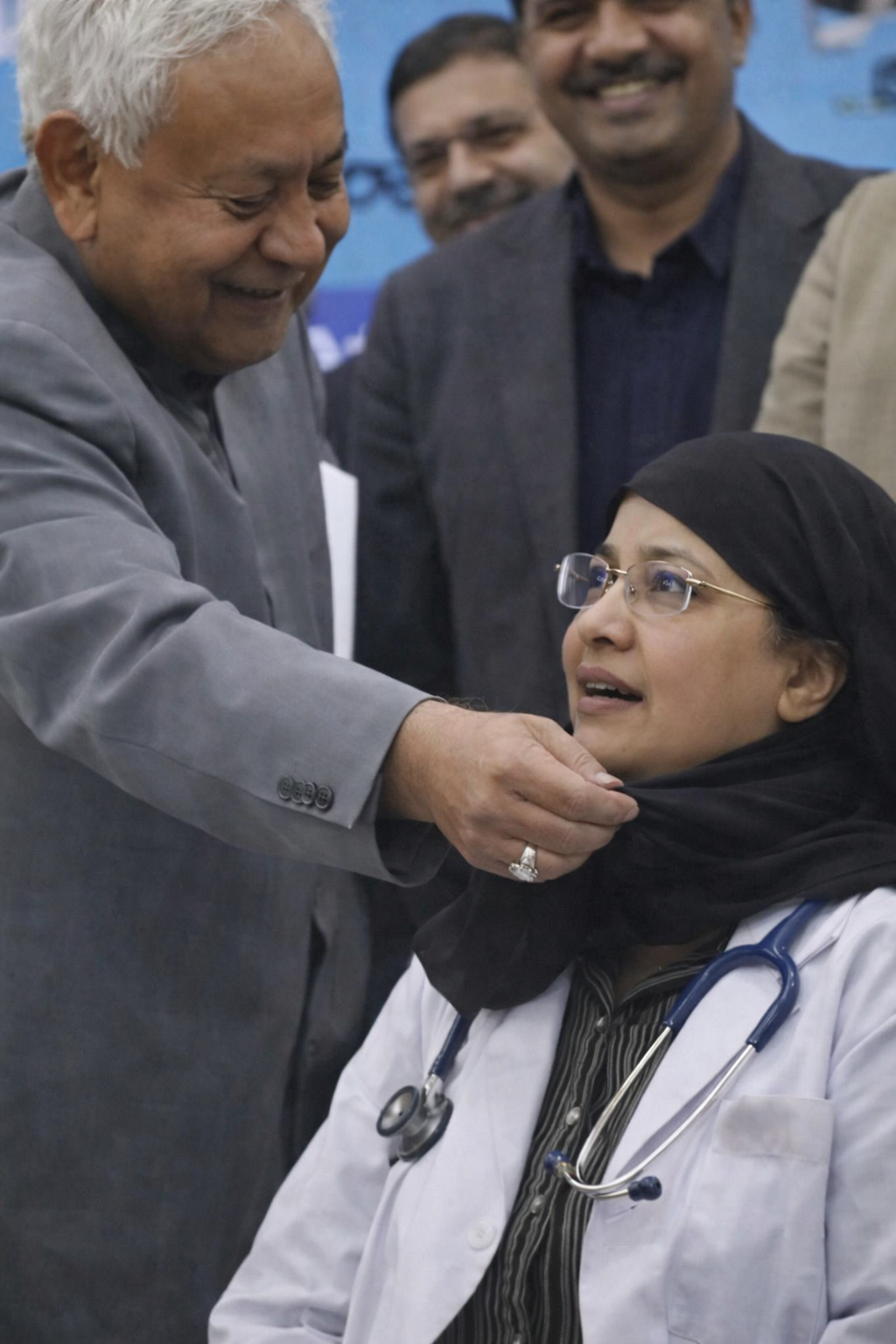
A Muslim woman—
doctor of healing hands,
scholar of steady mind—
steps forward to receive her due.
The Chief Minister of Bihar,
Mr. Nitish Kumar,
extends recognition,
and history pauses to take notes.
This is New Delhi,
where words often shout louder than wisdom,
where cloth becomes controversy,
and faith is questioned by those
who have never learned its language.
She wears her hijab
not as a wall,
but as a will.
Not as defiance,
but as devotion.
Not as silence,
but as a voice wrapped in grace.
Let it be written plainly,
so no headline may twist it:
No hand has the right
to pull another’s dignity.
No ideology, no fear, no slogan
grants permission to humiliate a woman—
not here, not anywhere,
not under any sky.
A hijab is not a threat.
It is a choice.
A crown of conscience.
A fabric of faith
that covers the body
but uncovers the soul’s resolve.
She stands tall—
not despite her belief,
but because of it.
Her knowledge has saved lives,
her oath has crossed borders,
her service has spoken
where prejudice tried to scream.
And to those who reach for force,
who mistake power for permission,
who tear at cloth thinking they tear at courage—
know this:
you only reveal your own emptiness.
I, Bilal Ahmad Bhat,
stand with the Honorable Doctor.
I stand with every woman
whose faith is questioned,
whose dignity is tested,
whose strength is underestimated.
Let the law remember its spine.
Let justice sharpen its sight.
Such practices must not be ignored,
must not be excused,
must not be normalized.
They must be punished,
for dignity delayed is dignity denied.
Today, an award is handed over,
but something greater is reclaimed:
the truth that a woman
needs no permission to exist as she is.
Applause rises—
not for cloth,
not for controversy,
but for courage.
And the stage becomes a lesson:
that a nation is strongest
when its women are safest,
when faith is protected,
when respect is non-negotiable.
Let this moment echo
beyond halls and headlines,
into classrooms, courts, and consciences—
that a woman’s dignity
is not up for debate.
She exits the stage,
award in hand,
honour intact,
and history walking beside her.
And somewhere,
a young girl watches,
learning that her faith is not a flaw,
her dignity not fragile,
and her future
very much her own.