
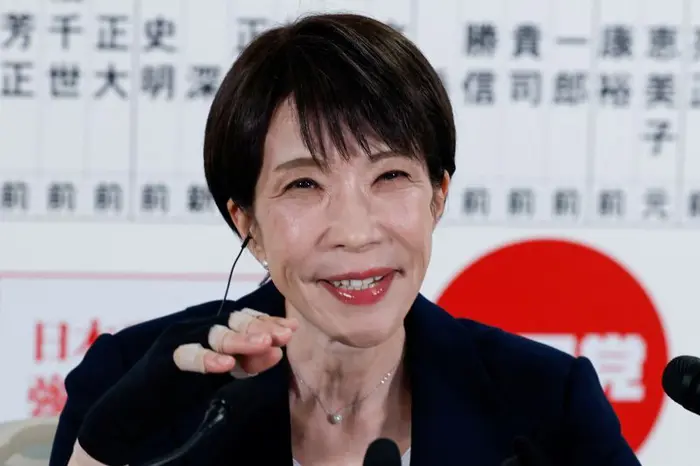
Japan has entered a new political chapter after a decisive election victory handed Prime Minister Sanae Takaichi a powerful mandate and intense scrutiny at the same time. With her Liberal Democratic Party securing a landslide win, attention has now shifted from campaigning to delivery, especially on her most talked-about promise, cutting the cost of living for ordinary households.
At the heart of that promise is Takaichi’s plan to suspend Japan’s 8 percent food sales tax for two years. She has long described this move as a personal mission, one aimed at easing pressure on families struggling with rising prices. The scale of the victory has strengthened expectations that she will act quickly, and she has already made it clear in post-election interviews that she intends to move fast.
Financial markets, however, remain uneasy. Japan carries the highest debt burden among developed nations, and investors are questioning how the government plans to fund a tax suspension that would cost an estimated 5 trillion yen annually, roughly equal to the country’s entire education budget. The lack of clear answers has already triggered volatility, pushing government bond prices down and dragging the yen close to historic lows before a partial recovery.
Some observers initially believed Takaichi’s strong mandate might give her the political room to soften or delay the plan. That idea was reinforced by the heavy defeat of opposition parties that had proposed even deeper tax cuts. But Takaichi pushed back firmly against that narrative, insisting that the election result strengthens, not weakens, her resolve.
Her commanding position within the LDP also reduces internal resistance from fiscal conservatives who have traditionally opposed tax cuts. Analysts say this shift in internal party dynamics significantly raises the likelihood that the food tax suspension will go ahead, even as debates over funding intensify.
Markets reacted sharply after the results. Japanese stocks jumped, bonds fell, and the yen regained some ground as investors anticipated decisive fiscal action. Government officials, meanwhile, stressed that they are closely monitoring currency movements amid heightened volatility.
The real challenge now lies in funding. Takaichi has ruled out issuing new debt but has yet to outline concrete alternatives. She has suggested that cross-party discussions on social welfare and taxation could unlock solutions, while past remarks have fueled speculation about using non-tax revenues, including Japan’s vast foreign exchange reserves. Any move in that direction, especially involving U.S. Treasury holdings, could unsettle global markets and raise concerns internationally.
Analysts warn that prolonged uncertainty could spark another sell-off in bonds, driving up borrowing costs for a country already carrying debt worth roughly twice its economic output. A weaker yen could also push import prices higher, potentially offsetting the benefits of tax relief for households.
Market watchers caution that public support alone may not be enough. Investor confidence could become the prime minister’s toughest test. If fears over fiscal sustainability grow, currency weakness and higher food prices could quickly erode public goodwill.
Since taking office last October, Takaichi has already had to scale back earlier proposals after market pushback. That experience appears to be weighing on her. In post-election interviews, she struck a notably serious tone, fully aware that expectations are now sky-high.
When questioned about responsibility if her government fails to deliver, she bristled but did not retreat. Her response captured the moment: a leader buoyed by public trust, yet fully conscious of the risks ahead.