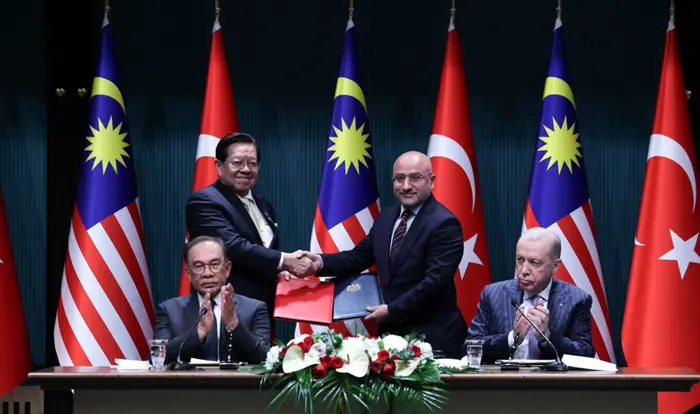
Malaysia and Turkiye have reaffirmed their commitment to strengthening a comprehensive strategic partnership following the inaugural meeting of the High-Level Strategic Cooperation Council held in Ankara. The landmark meeting, co-chaired by Turkiye President Recep Tayyip Erdoğan and Malaysian Prime Minister Datuk Seri Anwar Ibrahim, marked a new chapter in bilateral relations between the two nations.
In a joint statement issued by the Foreign Ministry, both leaders highlighted the depth of the longstanding friendship between Malaysia and Turkiye, grounded in shared democratic values, cultural bonds, and a mutual vision for peace, stability, and prosperity at the national, regional, and global levels.
The meeting also reflected tangible progress, with both sides expressing satisfaction over agreements signed during Prime Minister Anwar’s visit, particularly in trade and investment, information and communication technologies, and the defence industry. These agreements signal a clear intent to translate diplomatic goodwill into real economic and strategic outcomes.
On the economic front, Malaysia and Turkiye acknowledged steady growth in bilateral trade and reiterated their ambition to reach a target of US$10 billion. Leaders emphasized the importance of fully utilizing the Malaysia–Turkiye Free Trade Agreement while expanding cooperation into emerging sectors such as agriculture, manufacturing, digital trade, and services. Strengthening collaboration within the global halal economy was also reaffirmed as a shared priority.
Beyond trade, both countries agreed to deepen bilateral investments and enhance cooperation in logistics, maritime connectivity, port development, aviation, and emerging economic corridors linking Europe, the Middle East, and the Asia-Pacific. Special attention was given to supporting collaboration among small and medium-sized enterprises, recognizing their role as drivers of innovation and inclusive growth.
Civil aviation was highlighted as a critical enabler of connectivity, with leaders encouraging continued consultations between aviation authorities to ensure efficient and sustainable air transport operations, including cargo and passenger services. The engagement of business leaders during the Turkiye–Malaysia Business Roundtable was also welcomed as a positive step toward stronger private-sector collaboration.
In defence and security, both sides underscored the strategic importance of bilateral cooperation, particularly in military science, technology, and the defence industry. They agreed to deepen collaboration on high-technology projects to strengthen a joint defence industry ecosystem. Commitments were also made to enhance military capacity building through education and training opportunities for cadets and officers in both countries.
The leaders reiterated their shared resolve to combat transnational organised crime and terrorism in all its forms, emphasizing the need for strong international cooperation to address evolving security challenges in an increasingly complex global landscape.
Energy and sustainability featured prominently in discussions, with both nations expressing intent to expand cooperation in energy transition, renewable energy, nuclear energy, clean hydrogen, and battery technologies. They reaffirmed their shared responsibility to address climate change in line with the Paris Agreement and the Sustainable Development Goals. In this context, opportunities for continued engagement on climate action were welcomed ahead of Turkiye’s Presidency of the 31st Conference of the Parties under the UN Framework Convention on Climate Change.
People-to-people ties were also prioritized, with agreements to strengthen cooperation in culture, education, tourism, and media. Turkiye expressed its support for Malaysia’s “Visit Malaysia 2026” initiative, reflecting confidence in tourism and cultural exchanges as pillars of long-term friendship.
On regional and global issues, both leaders reaffirmed their support for the Palestinian people and the establishment of an independent State of Palestine. They stressed the urgency of humanitarian access to Gaza, the importance of multilateralism, and the need for meaningful reform of the United Nations.
The joint statement concluded that the inaugural High-Level Strategic Cooperation Council has laid a strong foundation for a comprehensive roadmap to deepen bilateral ties. Both sides agreed to convene the second council meeting in Malaysia in 2028, signaling sustained momentum in the Malaysia–Turkiye partnership.
At its core, this meeting was not just about policies and agreements. It was about two nations choosing to walk forward together, building trust, opening doors for businesses and communities, and committing to cooperation that reaches beyond borders for the benefit of future generations.