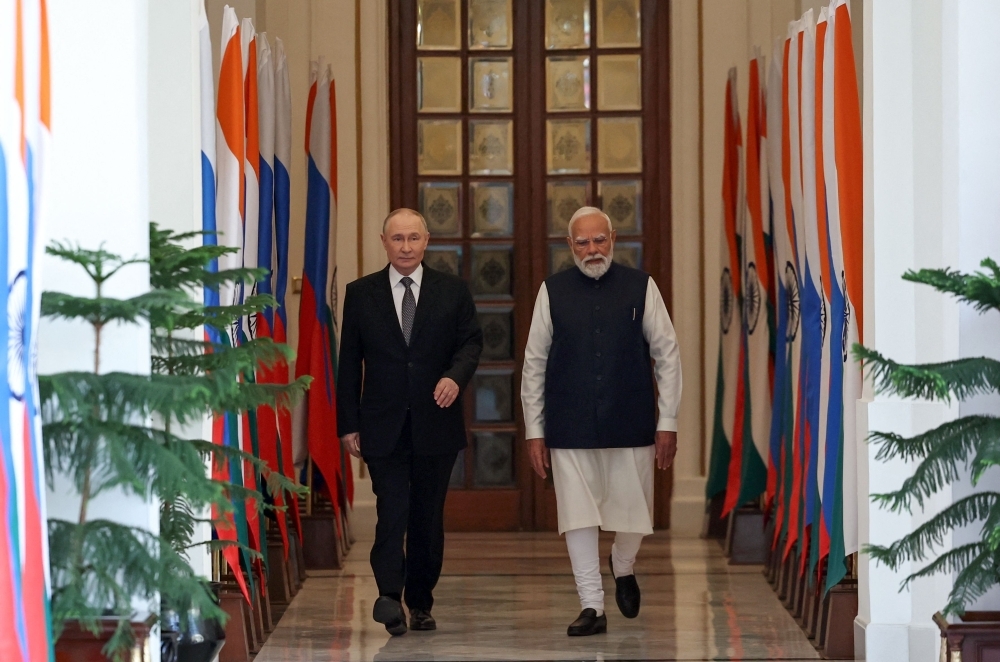
India’s Prime Minister Narendra Modi welcomed Russian President Vladimir Putin in New Delhi today for a highly watched summit that placed defence cooperation, energy security, and trade relations at the centre of discussions—at a time when India faces mounting pressure from the United States to curb its imports of Russian oil.
Putin received a ceremonial red-carpet reception, complete with an honour guard and a 21-gun salute, before beginning formal talks with Modi at the presidential palace. This marks Putin’s first visit to India since the start of the war in Ukraine.
The agenda carries significant weight: major defence agreements, co-production deals, energy purchases, and expanded economic collaboration. Sitting beside Modi during the opening session, Putin said he anticipated a “fruitful” day reviewing “a great number of documents” involving defence, technology, aviation, and space cooperation.
Both leaders are also set to examine shifting geopolitical dynamics—from the ongoing conflict in Ukraine to the global economic strain created by new tariffs introduced by US President Donald Trump.
Modi personally welcomed Putin at the airport on Thursday with a warm embrace, followed by the two leaders travelling together in the same vehicle to a private dinner—echoing a similar gesture during their last meeting in China. Modi later shared a photo of the moment, writing that the India-Russia partnership is “time-tested” and deeply beneficial to both nations.
Their show of solidarity comes at a sensitive time. Trump’s recent 50-percent tariffs on most Indian goods were imposed partially because of New Delhi’s continued purchase of discounted Russian oil, which Washington argues indirectly supports the war in Ukraine.
Putin noted that he briefed Modi extensively on developments in Ukraine and ongoing discussions with global partners—including the United States—about potential pathways to peace. Modi reiterated that India stands “on the side of peace,” underscoring the nation’s diplomatic balancing act.
A Strategic Tightrope
India’s foreign policy is navigating complex terrain—maintaining access to essential Russian oil while avoiding further escalation of economic tensions with Washington.
“Balancing acts are second nature to Indian foreign policy making,” wrote former ambassador Pankaj Saran in the Times of India.
Ashok Malik of The Asia Group told AFP that the visit reflects India’s strategy to diversify its strategic and economic partnerships, especially at a time when US tariffs have created significant pressure.
Putin and Modi are expected to address business leaders and attend a state banquet hosted by President Droupadi Murmu later in the day.
India, now the world’s most populous country, has become a major destination for Russian oil—saving billions of dollars while offering Moscow a vital export market as European nations shift away due to the war. Putin also praised Modi during an interview, saying he is “not someone who gives in to pressure.”
Even so, Russia’s share of India’s arms imports has declined significantly—from 76 percent in 2009–13 to 36 percent in 2019–23—according to the Stockholm International Peace Research Institute. India aims to expand its exports and gain easier entry into Russia’s broader markets as bilateral trade reached US$68.7 billion in 2024–25, though Indian exports accounted for only a small fraction of that total.