Nepalans went to the polls on Thursday in a landmark election, choosing a new parliament in a tense contest between long-standing political figures and a rising youth movement. This comes six months after the deadly anti-corruption protests of 2025 that shook the nation and toppled the government.
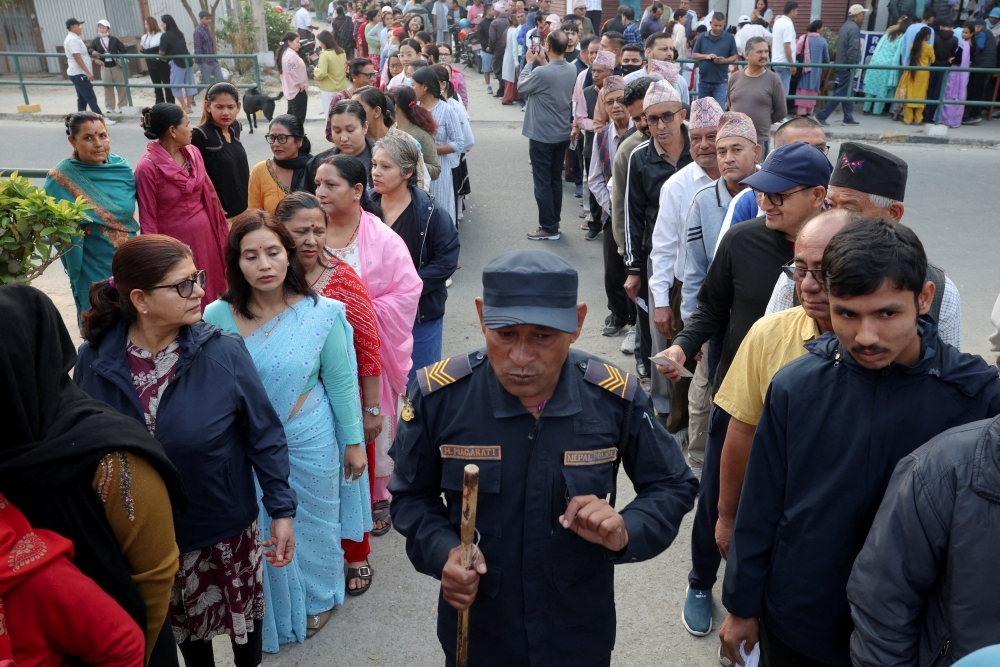
In the capital, Kathmandu, and the usually quiet town of Jhapa, voters lined up at dawn, eager to have their say in shaping the country’s future.
“I came early to vote because this is our right. Nepalis have been waiting for meaningful change for so long,” said Nilanta Shakya, 60, as she prepared to cast her ballot at a local college. “I hope this election brings the change we’ve been longing for.”
The election features high-profile candidates: KP Sharma Oli, the 74-year-old former prime minister and Marxist leader aiming for a comeback; Balendra Shah, a 35-year-old rapper-turned-politician appealing to the youth; and Gagan Thapa, 49, the newly elected leader of the Nepali Congress, calling for a break from decades of veteran leadership.
Nearly 19 million registered voters are deciding who will replace the interim government established after the September 2025 uprising, which left at least 77 dead and saw parliament and government buildings set ablaze. What began as youth-led protests over a brief social media ban escalated into widespread demands for transparency, economic reform, and an end to corruption.
Interim Prime Minister Sushila Karki assured citizens that they could vote safely, with thousands of security personnel deployed nationwide. “This election is critical in determining our future,” she said, thanking voters and calling for a peaceful process.
For many, the vote is more than a civic duty — it’s a moment of hope. “Today feels like a day of celebration,” said Nirmala Bhandari, 50, a housewife in Bhaktapur, who shared a video of herself dancing with friends after voting. “I hope our country gets new leaders and builds a better nation.”
Youth-Led Momentum and Historic Stakes
Across Nepal, helicopters delivered ballot materials to remote mountain communities, including regions near Mount Everest. But the spotlight is on the fertile plains south of Kathmandu, where all three prime ministerial candidates are competing for votes — a shift from past elections, which largely focused on the capital.
In the Jhapa-5 constituency, with roughly 163,000 voters, KP Sharma Oli is facing Balendra Shah. Shah, representing the centrist Rastriya Swatantra Party, is a symbol of the youth-driven call for change, while Oli represents the established order. Meanwhile, Gagan Thapa is campaigning for a departure from the entrenched political elite.
“At the Gen Z protests, people died — and their blood will bring change,” said Tek Bahadur Aale, 66, who voted in Jhapa. “We hope for a government with good governance and no corruption this time.”
More than 3,400 candidates are contesting 165 direct-election seats in Nepal’s 275-member House of Representatives, with the remaining 110 seats allocated via party lists. While some preliminary results may emerge within 24 hours, full results — especially under the proportional representation system — could take longer, with coalition negotiations adding further uncertainty.
“I’ve seen many elections and many old leaders,” said Lokamundra Devi Dahal, 68, after casting her vote in Jhapa. “I hope for real change this time — for our children and our future.”
As Nepal awaits the results, the nation stands at a historic crossroads. Citizens are not just casting votes; they are placing their hopes, frustrations, and dreams into the hands of a new generation of leaders determined to shape a fresh path forward.