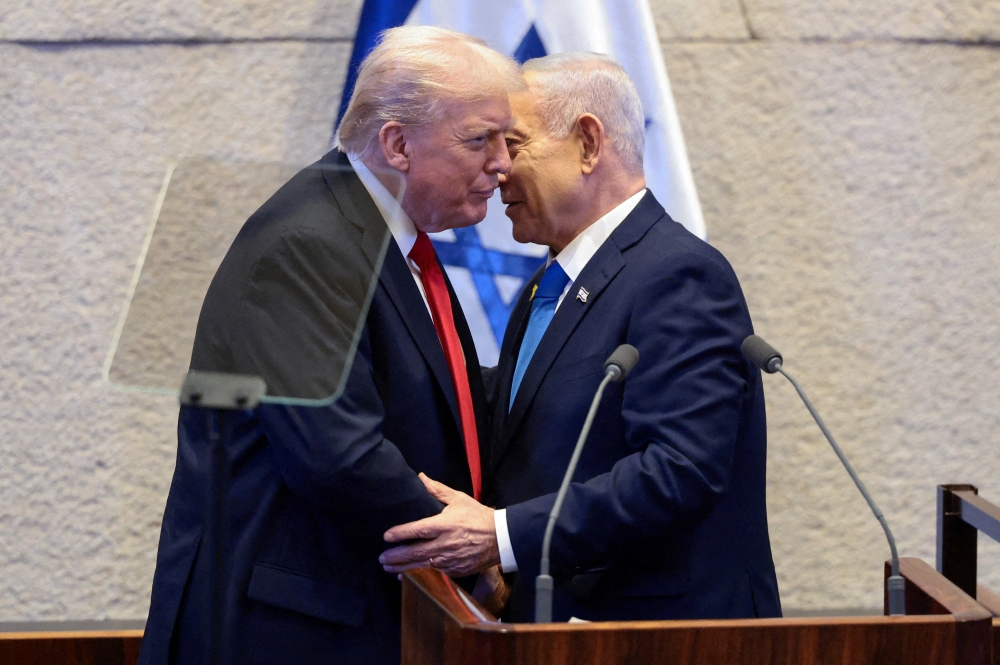
Prime Minister Benjamin Netanyahu has confirmed that Israel will participate in US President Donald Trump’s newly launched “Board of Peace” initiative, marking a significant diplomatic development during his recent visit to Washington.
Following his meeting with US Secretary of State Marco Rubio on Wednesday, Netanyahu announced on social media that he had formally signed Israel’s accession to the Board of Peace. The announcement came during high-level talks in Washington, where Netanyahu also met President Trump to discuss regional security concerns, particularly Iran.
The Board of Peace was authorized through a United Nations Security Council resolution adopted in mid-November. The resolution permits the establishment of an international stabilization force in Gaza under the Board’s framework. A fragile ceasefire in Gaza, which began in October under a Trump-brokered plan agreed upon by Israel and the Palestinian militant group Hamas, created the conditions for the Board’s formation.
Initially, the Board was designed to oversee Gaza’s temporary governance during a transitional period. However, Trump later expanded the initiative’s scope, announcing that the Board — with himself as chair — would also address broader global conflicts beyond Gaza.
The Board is scheduled to hold its first official meeting on February 19 in Washington, with Gaza’s reconstruction expected to dominate the agenda.
Rising International Debate
The initiative has already generated strong reactions across diplomatic and human rights circles. Some legal scholars and rights experts argue that a foreign-led body supervising Gaza’s governance structure resembles a colonial-style arrangement. Concerns have also intensified over Israel’s participation, particularly given the absence of Palestinian representation on the Board.
Several countries have responded cautiously to Trump’s invitation to join the initiative. While some Middle Eastern allies of Washington have agreed to participate, many traditional Western partners have refrained, reflecting uncertainty about the Board’s long-term implications and its potential overlap with United Nations authority.
Critics warn that the structure could weaken existing UN mechanisms, while supporters argue that a new framework may accelerate reconstruction and stabilization efforts in Gaza.
Ceasefire Under Strain
Meanwhile, the ceasefire in Gaza remains fragile. Gaza health officials report that at least 580 Palestinians have been killed since the ceasefire began in October, while Israeli sources say four Israeli soldiers have died during the same period.
According to Gaza’s health ministry, more than 72,000 Palestinians have been killed since Israel launched its military campaign following the late 2023 Hamas-led attack that killed approximately 1,200 people in Israel and resulted in more than 250 hostages being taken.
The conflict has led to widespread destruction across Gaza, severe food shortages, and the displacement of nearly the entire population. Multiple human rights experts, academic scholars, and a UN inquiry have described the scale of devastation as potentially amounting to genocide — a charge Israel strongly rejects, maintaining that its military actions constitute self-defense.
A Region Watching Closely
As the Board of Peace prepares for its inaugural meeting, global attention is fixed on what this initiative will mean for Gaza’s future — and for international diplomacy more broadly. Supporters hope it could pave the way for reconstruction and stability. Critics fear it may deepen divisions and complicate efforts toward a lasting political solution.
Beyond political strategy and international negotiations lies a human reality: families grieving lost loved ones, children growing up amid rubble, hostages still separated from their homes, and communities on both sides longing for safety. While leaders debate governance structures and resolutions, ordinary people continue to bear the weight of decisions made far from their neighborhoods.
Whether the Board of Peace becomes a turning point toward stability or another layer in an already complex conflict remains to be seen. What is certain is that the stakes are profoundly human — measured not only in diplomatic agreements, but in lives affected every single day.