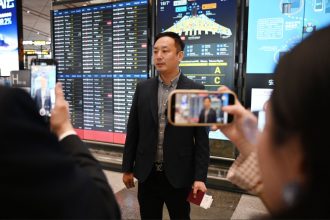
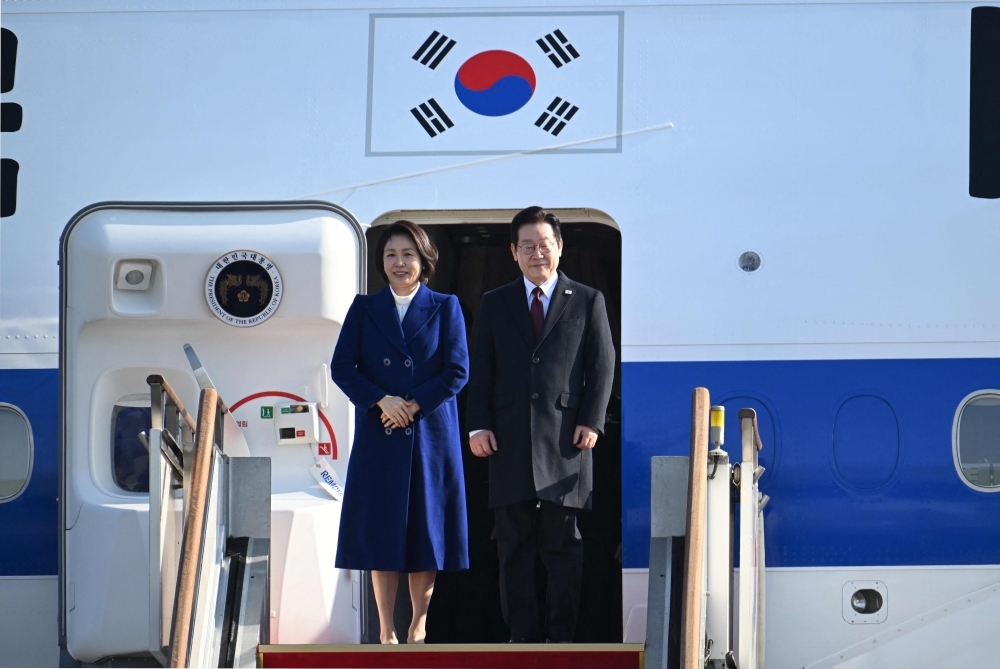
South Korean President Lee Jae Myung embarked on a significant four-day trip to China today, aiming to enhance economic ties with Seoul’s largest trading partner while carefully navigating sensitive regional issues, including Taiwan.
This marks the first visit by a South Korean leader to Beijing in six years, coming just days after China conducted massive military drills around Taiwan, featuring missiles, fighter jets, navy ships, and coastguard vessels. The exercises drew widespread international criticism, but notably, South Korea chose not to join the chorus of condemnation.
President Lee is traveling with a high-profile delegation of business and tech leaders, including executives from Samsung and Hyundai Motor Group, alongside figures from South Korea’s entertainment and gaming sectors. The delegation aims to discuss expanded economic cooperation, potential collaboration in artificial intelligence, and opportunities for trade that are “more horizontal and mutually beneficial,” as Lee emphasized.
The president also hopes to leverage China’s influence over North Korea to support his broader vision of improving inter-Korean relations. Hours before Lee’s departure, South Korea reported that North Korea had fired a ballistic missile into the Sea of Japan, marking its first weapons test of the year.
Seoul has long balanced its relationships between China, its largest trading partner, and the United States, its chief defense guarantor. Experts like Kang Jun-young, a professor at Seoul’s Hankuk University of Foreign Studies, warn that Beijing may now try to pull South Korea further from Washington’s sphere of influence, especially as trilateral cooperation between South Korea, the U.S., and Japan grows.
Throughout recent months, Lee has deliberately stayed neutral in regional disputes, including tensions between China and Japan. He stressed last month that “taking sides only worsens tensions” and has avoided commenting on potential South Korean involvement in any Taiwan conflict. In a recent interview with Chinese state media, Lee reaffirmed his commitment to “respecting the one-China principle” and maintaining peace and stability across Northeast Asia, including the Taiwan Strait.
Economically, Lee’s visit underscores Seoul’s ambition to deepen business ties with China. Meetings with President Xi Jinping and top Chinese officials, including Premier Li Qiang, will cover trade, investment, and even cultural exchange, potentially easing a near-decade-long unofficial ban on K-pop and Korean content in China. Lee will also travel to Shanghai, a hub for South Korean businesses, where he will attend a startup summit and visit historical sites tied to Korea’s government-in-exile.
This visit is not just about economics or diplomacy—it reflects Lee’s careful balancing act: strengthening ties with China, maintaining security partnerships with the U.S., and exploring avenues for peace with North Korea, all while keeping regional tensions in check. As South Korea navigates these delicate waters, President Lee’s trip may set the tone for both economic and political cooperation in East Asia for years to come.