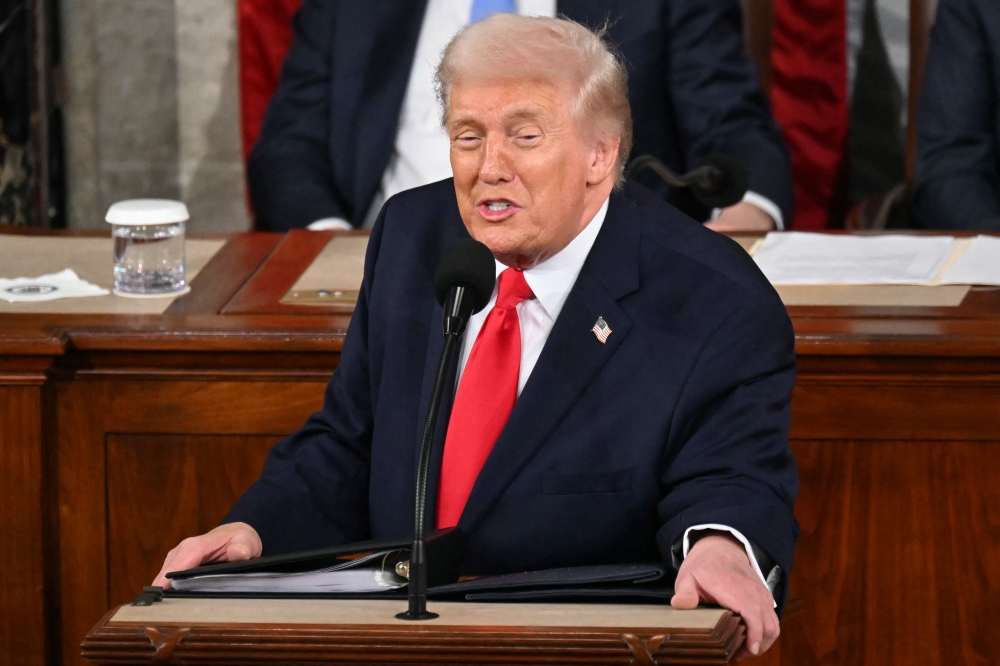
In a speech that stretched into the history books, US President Donald Trump declared what he called a “turnaround for the ages,” presenting a confident vision of America’s future even as political tensions simmered both at home and abroad.
Speaking before a joint session of Congress, Trump was met with repeated standing ovations from Republican lawmakers. Across the aisle, many Democrats remained seated in visible protest, with some voicing objections during the address. The sharp divide in the chamber reflected a nation still grappling with deep political polarization.
From the outset, Trump painted an optimistic picture of the country’s direction.
“Tonight, after just one year, I can say with dignity and pride that we have achieved a transformation like no one has ever seen before,” he said, insisting that America is now “bigger, better, richer and stronger than ever before.”
The primetime address, broadcast nationwide, comes at a critical moment for the 79-year-old president. With midterm elections approaching, Trump and his Republican Party face mounting pressure. Recent polls show his approval ratings hovering at challenging levels, raising concerns that Republicans could lose control of Congress — a shift that could stall his legislative agenda and intensify political scrutiny.
Rising Global Tensions and Diplomacy Signals
Amid reports of increased US naval and air deployments in the Middle East, Trump addressed concerns about Iran. He claimed Tehran is seeking missile capabilities capable of reaching US territory and reiterated his stance that Iran would never be allowed to obtain a nuclear weapon.
“Iranians are at this moment again pursuing their sinister nuclear ambitions,” he said.
However, Trump also signaled openness to diplomacy, stating that negotiations were ongoing and that his “preference is to solve this problem through diplomacy.” The dual message of strength and negotiation underscored his administration’s balancing act between deterrence and dialogue.
Celebrating National Pride
In a lighter moment, Trump shifted the focus to national pride, inviting members of Team USA’s Olympic ice hockey squad — fresh off a gold medal victory — to join him on the chamber floor. The move sparked loud chants of “USA” from supporters.
He then announced he would award the Presidential Medal of Freedom, the nation’s highest civilian honor, to the team’s goalie. Additionally, he presented Medals of Honor to a helicopter pilot injured during a January operation in Venezuela and to a 100-year-old Korean War veteran, drawing emotional applause from the chamber.
These moments appeared designed to rally bipartisan appreciation for service and achievement, even as political divides persisted.
A Shift in Tone
About an hour into the speech — which became the longest State of the Union address on record — Trump’s tone shifted noticeably.
He accused Democrats of “destroying our country” and criticized immigration policies, renewing calls for stricter voter identification laws. He repeated claims that US elections are plagued by “rampant” fraud — assertions that critics and election officials have repeatedly disputed.
Opponents argue that additional voter ID requirements could disenfranchise large numbers of eligible voters, intensifying an already heated debate over voting rights ahead of the midterms.
The president also addressed economic concerns. While touting progress, public surveys present a more complex picture. A recent Washington Post-ABC News-Ipsos poll showed Trump’s approval rating at 39 percent, with particularly low marks on inflation and the broader economy.
Complicating matters further, the Supreme Court recently struck down the administration’s use of broad trade tariffs. Though Trump briefly shook hands with several justices present at the speech, he later described the ruling as “very unfortunate.”
Political Stakes Ahead
With Republicans holding a narrow majority in the House and facing a competitive Senate map, November’s midterms loom large. A shift in congressional power could dramatically reshape Trump’s second-term agenda and political trajectory.
The speech was not just a policy address — it was a campaign moment. A declaration of resilience. A public attempt to reclaim momentum.
Yet outside the chamber, Americans remain divided on the direction of the country. Economic anxieties, immigration debates, foreign policy tensions, and institutional clashes continue to define the national conversation.
The Human Reality Behind the Headlines
Beyond the applause lines, protests, and polling numbers lies a deeper truth: moments like this are about more than political rivalry. They are about the future ordinary families are trying to build — parents worried about inflation, veterans seeking recognition, workers navigating uncertainty, and young voters deciding what kind of nation they want to inherit.
For some Americans, the speech symbolized strength and renewal. For others, it reinforced concern and division. But for all, it marked another chapter in a story that continues to unfold in living rooms, workplaces, and communities across the country.
As the midterms approach, one thing is certain — the debate over America’s path forward is far from over.