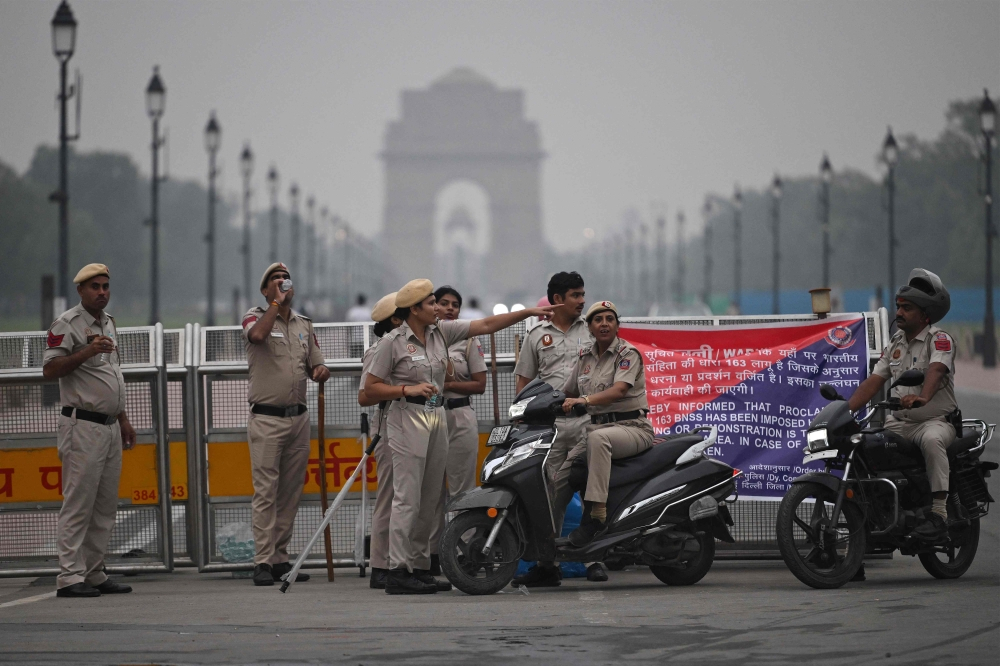
India has stepped up security across New Delhi and imposed transportation restrictions ahead of major demonstrations demanding the resignation of the country’s election chief over allegations of irregularities in voter registration. The planned protests have intensified political tensions, bringing renewed attention to electoral transparency, democratic accountability and the right to peaceful assembly.
The demonstrations were organised by the youth-led Cockroach Janata Party (CJP), which has mobilised supporters in recent weeks following allegations of misconduct during a nationwide revision of India’s electoral rolls. The protests follow a newspaper investigation published last month that raised questions about the Election Commission of India’s handling of the voter-list revision.
The Election Commission of India (ECI) has rejected allegations of wrongdoing, maintaining that its special intensive revision was designed to identify duplicate registrations and remove people who are no longer eligible to vote. However, opposition parties and critics have expressed concern that the process could exclude eligible voters, potentially affecting marginalised communities and benefiting Prime Minister Narendra Modi’s ruling Bharatiya Janata Party (BJP).
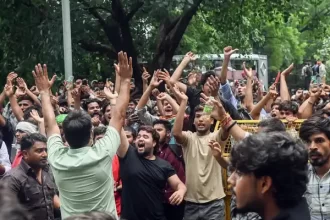
Authorities deployed thousands of police officers and paramilitary personnel throughout the capital ahead of the planned demonstrations. Multiple layers of yellow metal barricades were installed on roads leading to Jantar Mantar, a designated protest location frequently used for political demonstrations. Police did not authorise rallies at the site for the weekend, adding to tensions between protesters and authorities.
The latest mobilisation is widely viewed as a continuation of the CJP’s protest campaign in July, which reportedly contributed to the resignation of an education minister following an examination scandal. This time, demonstrators are demanding the resignation of Election Commission chief Gyanesh Kumar, making electoral accountability the central issue of the campaign.
Transport restrictions spark further criticism
Security measures have also affected public transportation in and around New Delhi. Authorities ordered the closure of dozens of metro stations and cancelled several trains travelling to the capital, raising concerns about disruption to commuters and people travelling to participate in the demonstrations.
India’s Supreme Court intervened on the transportation issue, stating that some trains should continue operating and that authorities should not impose a blanket closure of metro stations. The intervention highlighted the challenge of balancing public security measures with the need to maintain essential transportation services.
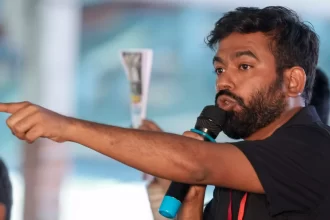
CJP chief Abhijeet Dipke criticised the restrictions in a statement posted on X, arguing that shutting down transportation and restricting access to protest areas would inconvenience ordinary citizens rather than resolve the underlying political dispute. The party has maintained that peaceful demonstrations should be allowed to proceed without unnecessary interference.
The CJP, which emerged online as a satirical political movement in May, has also accused authorities of intimidating supporters ahead of the demonstration. The organisation claimed that at least 10,000 people, including individuals travelling to Delhi by train, had been detained across the country. These figures and allegations have not been independently established in the supplied report, and police had not responded to the party’s broader claims of mass detentions.
Reports cited by The Hindu newspaper said that some people detained in Madhya Pradesh, a state in central India, had been taken to hotels. The reported detentions have added another dimension to the controversy, with concerns emerging over freedom of movement and the treatment of political demonstrators.
Neha Bora, who has become one of the prominent figures associated with the current protest movement, expressed the determination of supporters to continue their campaign despite the restrictions. The movement’s message reflects a broader debate over whether administrative and security measures are being used appropriately when citizens seek to challenge public institutions.
Electoral roll revision at the centre of the dispute
The controversy centres on a nationwide voter-list revision that began in 2025. According to the report, more than 133 million names were excluded from draft electoral rolls during the exercise. The exclusions reportedly included duplicate entries and records relating to people who had died.
The Election Commission has defended the process, stating that it is intended to identify fraudulent registrations, improve the accuracy of voter lists and prevent ineligible individuals, including alleged foreign illegal immigrants, from participating in elections.
Critics, however, argue that large-scale revisions can carry serious consequences if eligible citizens are mistakenly removed or face difficulties proving their eligibility. They have raised concerns about the potential disproportionate impact on economically disadvantaged people, minority groups and communities that may struggle to access documentation or navigate administrative procedures.
Members of the BJP have long alleged that undocumented Muslim migrants from neighbouring Bangladesh have fraudulently entered Indian electoral rolls. Such claims remain politically contentious, and allegations concerning individual groups should not be treated as proof that any particular community has engaged in electoral fraud.
For a country with one of the world’s largest electorates, the accuracy and accessibility of voter registration are fundamental to public confidence in democratic institutions. Electoral authorities must be able to identify fraudulent entries, but the process must also protect eligible voters from wrongful exclusion and provide clear mechanisms for challenging errors.
A wider test for democratic accountability
The developments in New Delhi reflect a growing confrontation between protesters demanding electoral accountability and authorities responsible for maintaining public order. The outcome may influence public debate over the independence of election administration, political participation and the limits of government restrictions during demonstrations.
At the heart of the dispute is a question that extends beyond political parties: how can a democracy ensure that its electoral rolls remain accurate without undermining the voting rights of eligible citizens?
For ordinary people, the issue is deeply personal. A name missing from a voter list can mean losing the opportunity to participate in decisions that shape education, employment, public services and the country’s future. Equally, public confidence depends on transparent procedures, credible evidence and a fair opportunity for people to challenge mistakes.
As demonstrations gather momentum, the key test will be whether the authorities, the Election Commission and political opponents can address the allegations through transparent and accountable processes while respecting peaceful assembly and citizens’ democratic rights. The credibility of an election system depends not only on preventing fraud, but also on ensuring that every eligible voter has a fair opportunity to be heard.