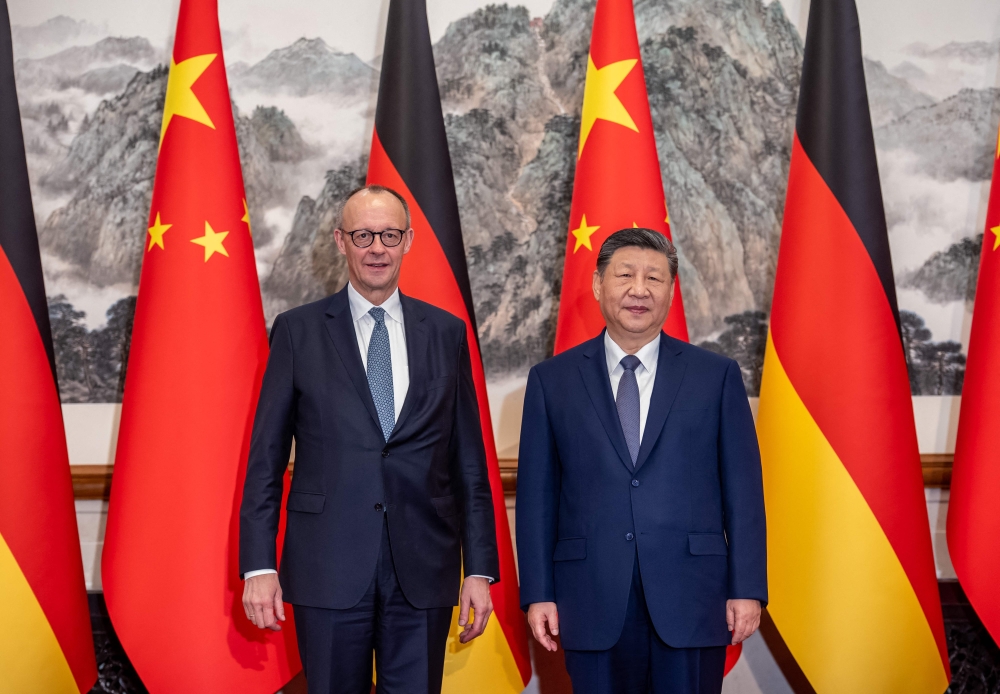
Beijing, China — German Chancellor Friedrich Merz announced yesterday that China will purchase up to 120 aircraft from Airbus, a landmark deal that underscores Berlin’s efforts to deepen economic ties with Beijing. The announcement came after high-level talks with President Xi Jinping, highlighting a push for closer collaboration between Europe’s largest economy and the world’s second-largest.
Merz’s visit comes at a critical time, as Germany and China navigate a global landscape marked by trade uncertainty and the aftershocks of previous US tariff policies. Last year, China overtook the United States as Germany’s largest trading partner, yet Berlin continues to view Beijing as a systemic rival with complex geopolitical implications.
Following discussions with Chinese leaders, Merz expressed optimism about the deal. “China’s agreement to purchase up to 120 Airbus aircraft demonstrates how worthwhile such trips can be,” he told reporters, adding that additional contracts were in progress.
Both leaders emphasized the importance of strengthening strategic relations. Merz called the visit a “great opportunity” to boost economic cooperation, while Xi signaled his willingness to elevate bilateral ties “to new levels.”
Sensitive Talks on Taiwan and Ukraine
Merz also addressed delicate international issues, including Taiwan and the ongoing war in Ukraine. He stressed that any reunification regarding Taiwan must happen peacefully, while Xi highlighted diplomacy as the key to resolving the conflict in Ukraine. According to state media Xinhua, Xi emphasized the “equal participation of all parties” and the need to address legitimate concerns to strengthen the foundation for peace.
Strengthening Economic Cooperation
Germany, heavily reliant on exports, has a vested interest in maintaining robust economic links worldwide. Merz, accompanied by a business delegation, met with Premier Li Qiang at Beijing’s Great Hall of the People. They signed multiple agreements, covering areas such as climate change, food security, and industrial cooperation.
In a pointed remark, Li noted that “unilateralism and protectionism have gained ground and even become prevalent in some countries and regions,” a likely reference to previous US trade policies.
China has occasionally flexed its economic muscle, restricting critical mineral exports vital for technology and renewable energy production, highlighting ongoing challenges for European businesses. Germany recorded a trade deficit of 89 billion euros (US$105 billion) with China last year, reflecting the complex balance of trade and investment.
Looking Ahead: Cars, AI, and Industry
Merz’s trip also focuses on Germany’s industrial interests. He is joined by executives from Volkswagen, BMW, and Mercedes, with visits planned to Beijing’s Forbidden City, a Mercedes autonomous-driving plant, and the AI hub in Hangzhou, home to robotics company Unitree and turbine manufacturer Siemens Energy.
German business leaders hope Merz will address issues like overcapacity, market distortions, and fairer access to Chinese markets. Wolfgang Niedermark of the Federation of German Industries emphasized that structural reforms in China are essential to prevent new trade conflicts with the EU.
Merz’s visit is part of a broader Western effort to maintain constructive relations with China, alongside recent trips by leaders including Britain’s Keir Starmer, France’s Emmanuel Macron, and Canada’s Mark Carney, reflecting a cautious but strategic engagement amid global uncertainty.