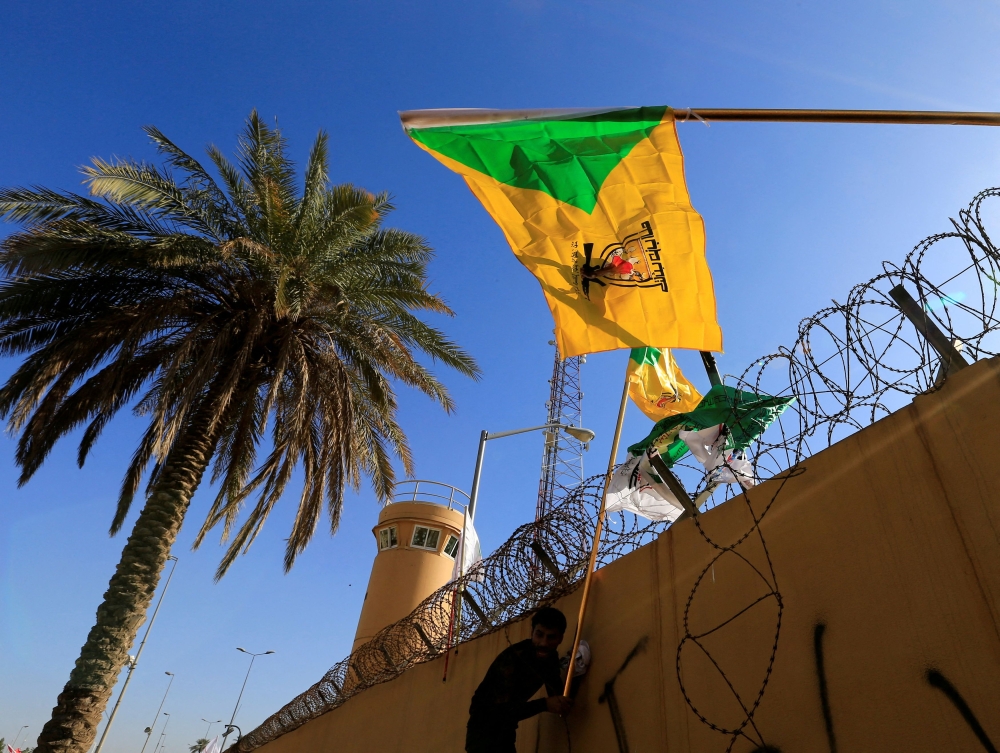
A powerful pro-Iran armed faction in Iraq has announced a temporary pause in attacks targeting the United States embassy in Baghdad, offering a brief window of calm amid a rapidly escalating regional conflict.
According to reports, the group pledged to suspend operations for five days, but only under certain conditions. One of the key demands includes halting Israeli airstrikes in parts of Beirut, along with assurances that residential areas in Baghdad and other Iraqi provinces will not be targeted.
So far, there have been no confirmed drone or rocket attacks on the US embassy in the Iraqi capital since the announcement. Observers say this development could signal a short period of reduced tension, though the situation remains highly fragile.
Iraq has found itself drawn into a broader regional confrontation that intensified after a US-Israel strike on Iran on February 28. Since then, Iran-backed factions across the region have claimed near-daily attacks on US interests, while retaliatory strikes have targeted groups aligned with Iran.
The armed faction Kataeb Hezbollah confirmed that its secretary-general had issued orders to halt attacks on the embassy in Baghdad during the five-day period. However, the group warned that if any of its conditions are violated, the response would be immediate and potentially lead to further escalation once the pause ends.
In recent days, the US embassy compound has been a repeated target of drones and rockets. Air defense systems have intercepted most of these projectiles, preventing major damage. A US diplomatic and logistical hub located at Baghdad International Airport, which also hosts military personnel, has similarly been targeted multiple times.
Security concerns have not been limited to Baghdad. Reports from Erbil, the capital of Iraq’s Kurdistan region, described several explosions over the city. Projectiles were reportedly intercepted in the air. Erbil hosts a significant US consulate complex and an airport where coalition forces are stationed, making it a sensitive strategic location.
Meanwhile, violence has also affected areas near Iraq’s western border with Syria. A recent strike in Anbar province killed three fighters belonging to the Hashed al-Shaabi, also known as the Popular Mobilisation Forces. This coalition of paramilitary groups is officially part of Iraq’s armed forces, though some factions within it maintain close ties with Iran and often operate independently.
Beyond the security crisis, the conflict is now impacting Iraq’s already fragile economy and energy infrastructure. Authorities confirmed that gas supplies imported from Iran were abruptly halted due to regional developments. The sudden disruption cut approximately 3,100 megawatts of electricity from Iraq’s power grid, raising concerns about power shortages across the country.
Officials attempted to reassure the public by stating that alternative fuels and domestic gas reserves would be used to stabilize electricity production. However, many Iraqis already face frequent power outages, and households commonly rely on private generators to cope with daily blackouts.
The gas supply interruption came shortly after Iran criticized strikes on facilities linked to the massive South Pars and North Dome gas field, one of the world’s largest natural gas reserves. The broader energy disruption highlights how interconnected the region’s conflicts have become, with ripple effects reaching infrastructure and daily life.
At the same time, Iraq is attempting to restore parts of its oil export operations. Authorities recently resumed shipments from the northern province of Kirkuk through a pipeline that runs via the Kurdistan Region to Turkey’s port of Ceyhan. However, the volume currently being exported is only a small portion of the country’s pre-war capacity.
Before the conflict escalated, Iraq exported millions of barrels of oil daily, much of it shipped through routes affected by tensions in the Strait of Hormuz. With those routes disrupted, the country’s economic stability faces additional pressure, as oil revenues make up the vast majority of Iraq’s foreign income.
For ordinary people across Iraq, the ongoing conflict is not just a geopolitical story unfolding on headlines. It directly affects electricity in their homes, stability in their cities, and the future of their livelihoods. While the five-day pause in attacks may offer a moment of relief, many Iraqis remain uncertain about what comes next in a region already burdened by years of instability and conflict.