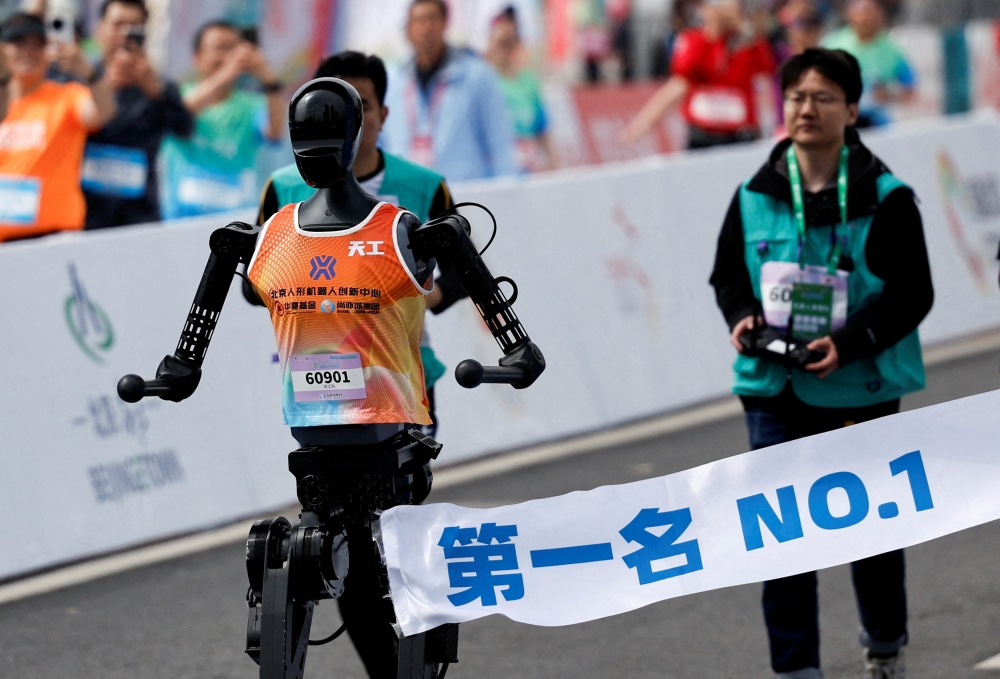
In a bold and futuristic display of innovation, China has once again put its artificial intelligence ambitions on full display—this time on the streets of Beijing. More than 300 humanoid robots have joined the country’s second robot half-marathon, tackling a demanding 21-kilometre course designed to test not just endurance, but the limits of robotics engineering itself.
This year’s race is bigger, tougher, and far more competitive. Over 70 teams have entered—almost five times more than last year—highlighting the rapid growth and intense interest in humanoid robotics. The route challenges participants with paved slopes, uneven parkland, and conditions that mimic real-world unpredictability.
Experts see this as more than just a spectacle. It’s a live experiment.
Georg Stieler, a robotics expert and Asia managing director at a technology consultancy, pointed out that the real focus lies in durability and battery performance. Developers are under pressure to balance innovation with affordability while constantly evolving their designs.
One of the most striking advancements this year is autonomy. Unlike last year—when all robots were remotely controlled—nearly 40 percent of participants are navigating the course independently. These robots rely entirely on sensors, algorithms, and real-time decision-making to complete the race.
Still, the journey is far from smooth.
Last year’s race saw multiple robots stumble, crash, or fail right at the starting line. Even the top performer, Tiangong Ultra, completed the race in 2 hours and 40 minutes—impressive for a machine, but still far behind human athletes. This year, Tiangong Ultra returns with full autonomy, trained through massive data simulations to replicate human-like movement.
But mimicking humans is no easy task.
At higher speeds, robots must process information and react almost instantly. This demands powerful computing, refined algorithms, and flawless system coordination. Training footage released on social media shows mixed results—some robots run fluidly at speeds up to 14 km/h, while others struggle with balance, jerky motion, or unexpected falls.
Despite these challenges, China remains the global leader in humanoid robotics. It accounts for over 80 percent of worldwide installations in 2025, far ahead of competitors. Companies like AgiBot and Unitree are scaling rapidly, each shipping thousands of units and planning even larger production capacities.
Yet, behind the impressive numbers lies a reality check.
Many experts argue that these robots are not yet ready for real-world industrial use. While they can run races or perform choreographed tasks, they still lack the intelligence, adaptability, and precision required in factories or daily life.
Some critics have gone as far as calling current demonstrations “dancing disguised as working,” pointing out that real-world applications demand far more than controlled performances.
The core issue? Intelligence.
Developers are still struggling to build AI systems that can match human reasoning, adaptability, and efficiency. Without high-quality data and smarter models, widespread adoption remains distant.
To bridge this gap, companies are investing heavily in data collection—using human workers with sensors and deploying robots into real environments to learn from experience. The scale of this effort is growing rapidly. One company increased its factory-based humanoid fleet from under 10 units to over 1,000 in just a year.
The goal is clear: turn humanoid robots from experimental showcases into everyday tools.
China sees embodied intelligence—AI integrated with physical systems—as a key driver of future economic growth. From manufacturing to service industries, the potential is enormous. But the road ahead requires breakthroughs not just in hardware, but in intelligence itself.
The Beijing robot half-marathon, while entertaining, is ultimately a glimpse into that future—a future still under construction.
And perhaps that’s what makes it so fascinating.
Behind every falling robot, every imperfect step, and every near-finish lies a powerful reminder: innovation isn’t perfect—it’s progress in motion.