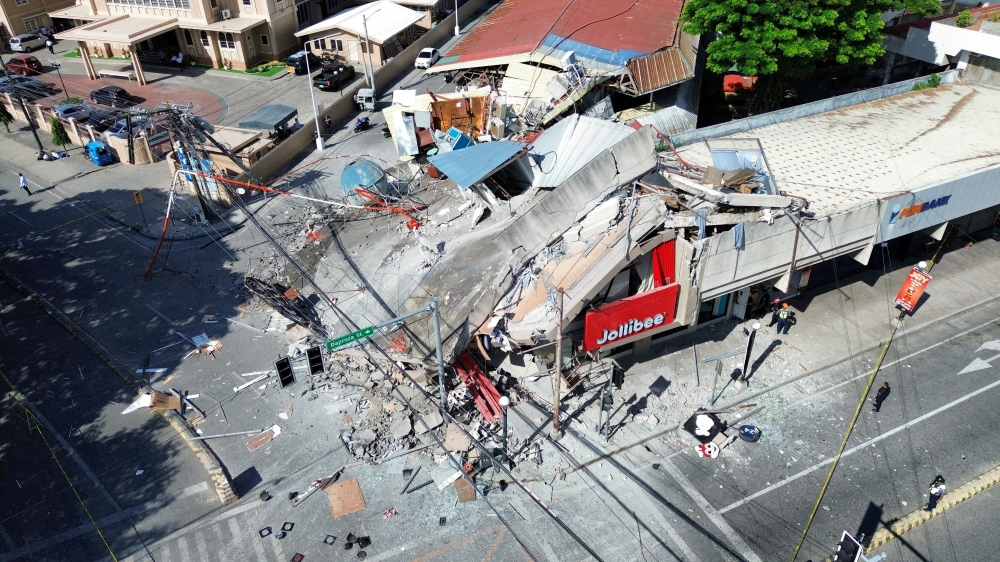
A powerful 7.8-magnitude earthquake struck off the southern coast of the Philippines today, causing widespread destruction, claiming at least 15 lives, and triggering tsunami warnings across multiple countries in the Asia-Pacific region.
The earthquake occurred offshore near General Santos City, one of the largest urban centers in southern Philippines, home to more than 700,000 residents. Following the quake, authorities immediately urged people living in coastal communities to evacuate and move to higher ground as a precaution against possible tsunami waves.
The powerful tremor was followed by a series of strong aftershocks. According to geological monitoring agencies, the largest aftershock measured 6.5 in magnitude, increasing fears of further structural damage and putting emergency responders on high alert.
Videos circulating online showed the devastating impact of the disaster. In General Santos City, parts of a shopping complex reportedly collapsed into rubble. A school building also crumbled during the earthquake. Fortunately, officials stated that the structure was unoccupied at the time, preventing what could have been a much larger tragedy.
Other footage captured terrified schoolchildren crying and clinging to their teachers as the ground shook violently beneath them. Witnesses described scenes of panic as buildings swayed and debris fell around them.
The Pacific Tsunami Warning Center issued alerts warning that tsunami waves could affect coastal areas of the Philippines, Indonesia, Palau, Taiwan, and Papua New Guinea. Neighboring countries closely monitored the situation as authorities assessed potential risks.
As rescue operations continued throughout the day, Philippine disaster officials confirmed at least 15 fatalities. Twelve deaths were reported in the Soccsksargen region, which includes General Santos City, while three additional deaths were confirmed in Davao Occidental province.
Local police also reported further casualties in nearby Alabel municipality, where individuals were trapped after a wall collapsed during the quake. Emergency teams have been working around the clock to search for survivors, assess damage, and provide assistance to affected communities.
In response to the disaster, Philippine President Ferdinand Marcos Jr. ordered the suspension of classes across Mindanao Island and appealed to residents in vulnerable coastal regions to evacuate immediately.
His message was clear and urgent: human life must come first.
In the coastal town of Kiamba, tens of thousands of residents moved to safer locations shortly after evacuation orders were issued. Regional disaster management officials reported that a large majority of the local population had already relocated to designated evacuation centers.
Transportation and infrastructure were also affected. Operations at General Santos Airport were suspended until authorities could complete safety inspections and determine the extent of damage.
The earthquake’s impact extended beyond the Philippines. Authorities in Malaysia and Indonesia issued precautionary warnings for coastal communities, while Japan monitored small tsunami waves reaching parts of its Pacific coastline.
The Philippines remains one of the most earthquake-prone nations in the world because it lies along the Pacific Ring of Fire, a region known for intense seismic and volcanic activity. Earthquakes occur frequently throughout the archipelago, and many communities continue to face the constant challenge of preparing for natural disasters.
This latest tragedy serves as a powerful reminder of nature’s unpredictability and the importance of disaster preparedness. While rescue operations continue and families mourn their losses, communities across southern Philippines are once again demonstrating resilience, courage, and unity in the face of adversity.
As the region begins the difficult process of recovery, the thoughts of many around the world remain with those who lost loved ones, homes, and livelihoods during this devastating earthquake.