
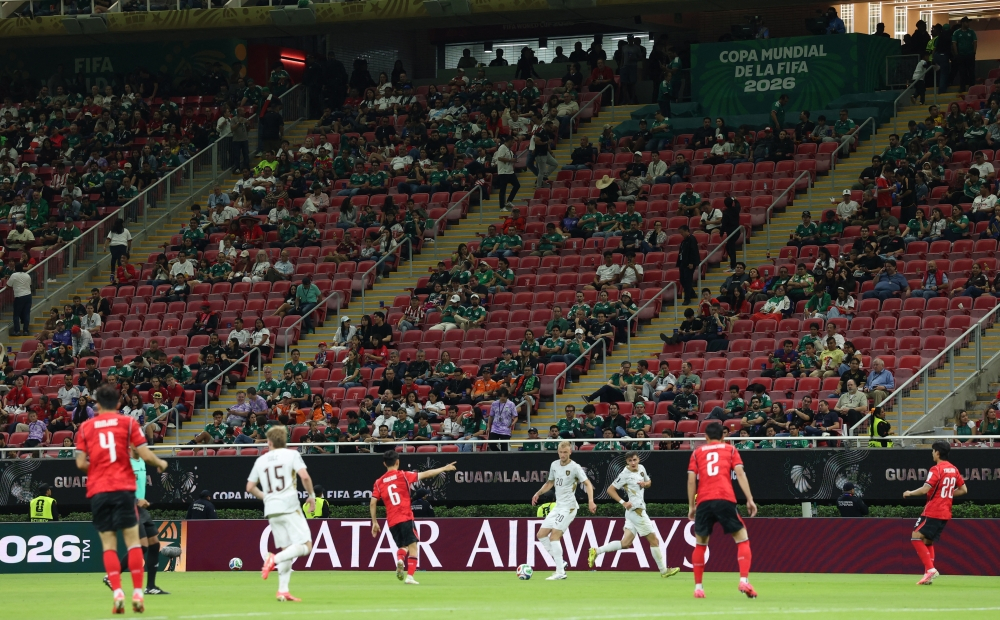
The sight of empty seats at a FIFA World Cup match has once again raised questions about whether ticket prices are becoming too expensive for ordinary football fans.
During the Group A clash between South Korea and the Czech Republic in Guadalajara, FIFA reported an official attendance of 44,985 spectators. However, visible sections of unoccupied seats throughout the stadium quickly became a talking point among supporters, analysts, and football communities worldwide.
The issue stands in stark contrast to the tournament opener, where more than 80,000 fans packed the iconic Azteca Stadium to witness co-host Mexico begin its World Cup campaign. The difference in attendance has fueled discussions about fan accessibility and the financial barriers associated with attending football’s biggest event.
Many supporters present at the Guadalajara stadium pointed directly to ticket costs as a major reason for the lower turnout. Several fans expressed frustration with FIFA’s pricing structure, arguing that attending World Cup matches has become increasingly difficult for average football enthusiasts.
The criticism comes despite FIFA’s insistence that demand for the tournament remains exceptionally strong. FIFA President Gianni Infantino recently defended the organization’s ticket pricing policy, stating that World Cup ticket costs are comparable to those seen at other major international sporting events.
According to FIFA, more than six million tickets have already been sold for the tournament. The organization has repeatedly highlighted overwhelming interest from fans across North America, South America, and other regions, with Infantino previously claiming that demand exceeded expectations by ten times or more.
Nevertheless, supporter groups remain concerned. Football Supporters Europe (FSE) has been among the most vocal critics, warning that high ticket prices risk excluding loyal fans who have traditionally formed the heart of World Cup atmospheres. The organization argues that ticket prices for the current tournament have increased dramatically compared to the 2022 FIFA World Cup in Qatar, with some categories reportedly costing several times more than previous editions.
Beyond the numbers, the empty seats have reignited a broader debate about the future of football’s premier tournament. As FIFA expands the World Cup to include 48 teams and seeks greater commercial growth, many supporters are asking whether affordability and accessibility are being sacrificed in the process.
For football fans, the World Cup has always been more than just a sporting event—it is a celebration of culture, passion, and global unity. The ongoing discussion surrounding ticket prices serves as a reminder that maintaining that connection with everyday supporters remains just as important as breaking attendance and revenue records.
On the pitch, South Korea secured a hard-fought 2-1 victory over the Czech Republic, earning valuable points in their Group A campaign. Yet for many observers, the conversation after the final whistle centered less on the result and more on the empty seats that continue to raise important questions about the cost of experiencing the world’s biggest football tournament.