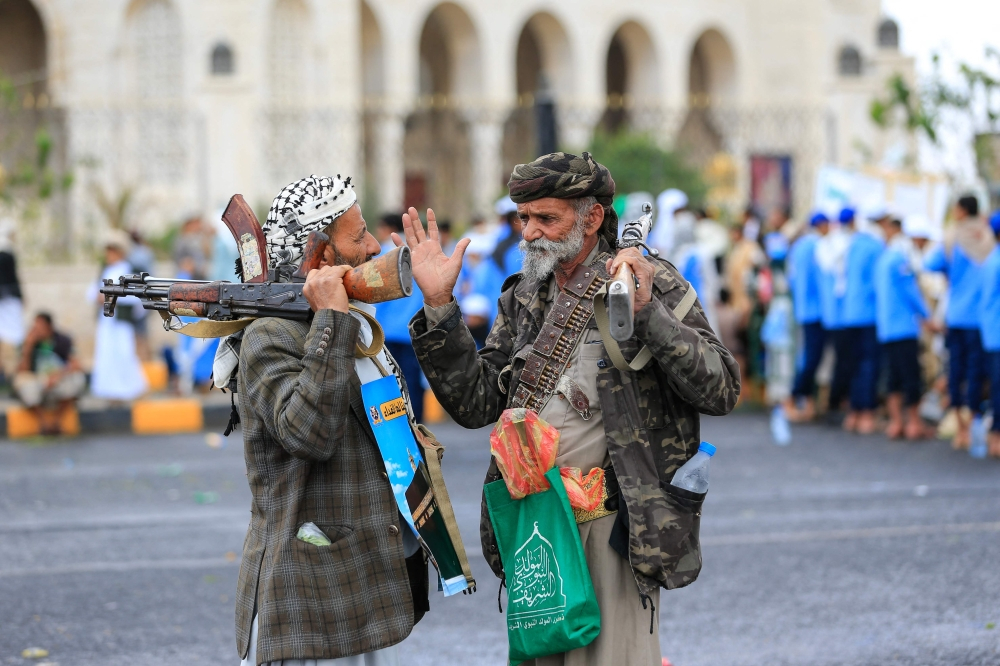
The Group of Seven has called on Yemen’s Houthi movement to immediately stop its attacks against Saudi Arabia, as growing military activity in the region adds another layer of uncertainty to an already fragile Middle East situation.
In a statement issued Tuesday, G7 countries including Canada, France, Germany, Italy, Japan, the United Kingdom and the United States urged the Houthis to end military operations and return to political dialogue.
The statement also called on Iran to stop providing arms and support to the Houthis, with the G7 alleging that such assistance violates previous United Nations Security Council resolutions.
The latest developments come as the Houthis have expanded their military operations along Yemen’s Red Sea coast. Their reported gains have raised concerns about shipping routes, energy supplies and the security of strategically important waterways used to transport oil and other goods.
The situation has also drawn Saudi Arabia more deeply into the latest escalation. Saudi Arabia has supported Yemen’s internationally recognised government since the conflict intensified in 2015, when a Saudi-led coalition intervened in the war.
According to the Houthi-affiliated Saba news agency, Saudi airstrikes on the strategic Red Sea port of Mokha killed at least six people and wounded eight others. The report has not been independently verified.
The strikes followed a Houthi attack targeting Riyadh on Saturday. The reported attack marked a significant escalation, particularly because attacks against the Saudi capital had been far less frequent in recent years.
The conflict in Yemen began in 2014 after Houthi forces seized control of the capital, Sanaa. Although fighting had largely remained frozen since 2022, recent developments have raised concerns that the conflict could once again expand and draw in more regional and international actors.
Britain and France Offer Defensive Support
The United Kingdom has also expressed support for Saudi Arabia. Media reports said Britain would provide defensive air-to-air refuelling assistance for Saudi aircraft.
France has similarly indicated that it is prepared to help protect Saudi energy infrastructure from attacks linked to the Houthis. A French diplomatic source told AFP that any assistance would remain strictly defensive and would not involve France directly joining the conflict with the Houthis.
The Houthis have previously targeted facilities associated with Saudi oil producer Aramco, including infrastructure connected to the country’s energy sector.
Saudi authorities have also reported disruptions involving the East-West Pipeline, an important route for transporting crude oil from the country’s eastern oil-producing regions toward the Red Sea.
These developments have renewed concerns about the vulnerability of energy infrastructure and international shipping routes in and around the Red Sea and Gulf region.
Diplomatic Pressure Grows
Yemen’s governing body has also sought greater international support. Rashad al-Alimi reportedly spoke with US President Donald Trump on Sunday, according to a source in Alimi’s office who spoke to AFP.
The source said the conversation was intended to demonstrate US solidarity with Yemen’s internationally recognised government, although Trump did not promise military assistance.
US media reports have also said that Saudi Crown Prince Mohammed bin Salman urged Trump to take action against the Houthis.
At the same time, Fox News reported that Trump had said the Houthis had agreed not to target US interests. Such claims highlight the rapidly changing diplomatic and military calculations surrounding the conflict.
A Wider Regional Concern
The Houthi movement, also known as Ansar Allah, has developed from a Yemeni faction into a major regional actor. The group takes its name from the Houthi family and is led by Abdulmalik al-Houthi.
In a speech on Monday, Abdulmalik al-Houthi said Saudi Arabia had carried out hundreds of airstrikes and warned countries such as Pakistan and Turkey against becoming involved in the conflict.
His comments came amid closer defence cooperation between Saudi Arabia, Pakistan and Turkey.
The three countries recently signed the Mecca Joint Defence Agreement, under which they committed to mutual defence if any of the three nations comes under attack.
The agreement has gained additional attention because of the wider instability involving Iran, the United States and armed groups supported by Tehran across the region.
For countries watching the situation closely, the concern goes beyond Yemen itself. Any prolonged disruption around the Red Sea, Gulf or other major maritime routes could have consequences for global trade, shipping costs and energy markets.
The G7’s latest statement reflects growing international concern over the possibility that the conflict could widen further.
For ordinary people across the region, however, the story is ultimately about more than military statements and geopolitical calculations. Continued fighting means greater uncertainty for families, businesses, workers and communities already living with the consequences of years of conflict.
The situation remains fluid, with diplomatic pressure, military operations and regional alliances continuing to shape what happens next.
This report is based on information and claims attributed to AFP, government statements, regional sources and media reports. Some battlefield and casualty claims could not be independently verified.