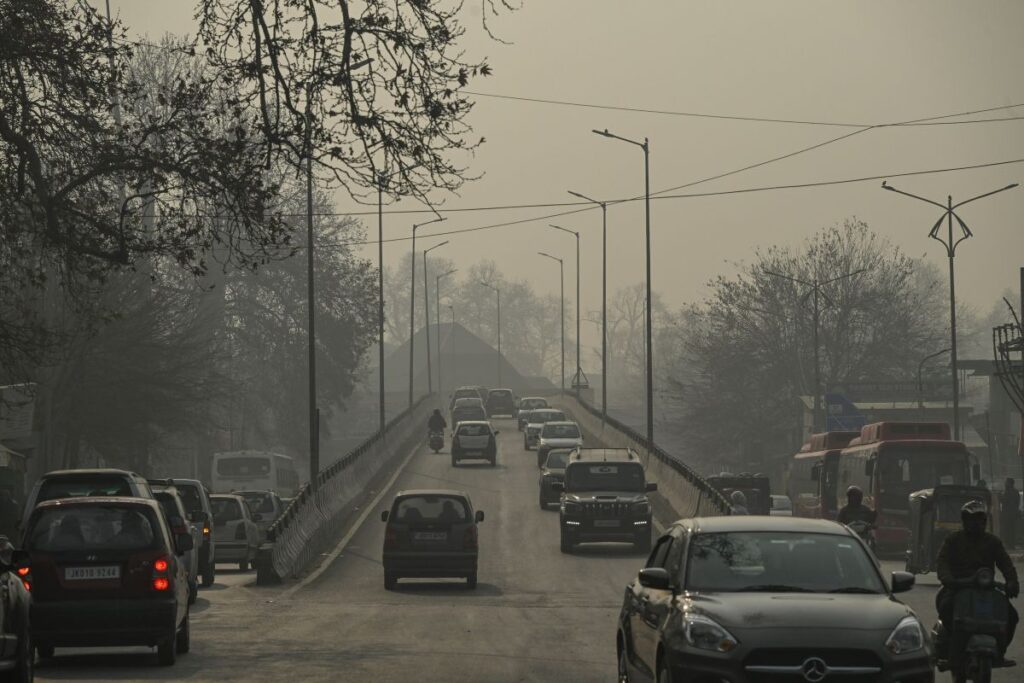
Srinagar has slipped to 26th position in the Centre’s 2026 Swachh Vayu Sarvekshan, raising fresh concerns about the city’s ongoing battle with air pollution. The latest assessment shows that while Jammu has made modest progress, Srinagar’s ranking and overall score have both declined compared with previous years.
Among cities with populations above 10 lakh, Srinagar ranked 26th in 2026, falling from 21st position in 2025. The decline is even more noticeable when compared with 2023, when Srinagar stood fourth in the same category.
The city’s score has also weakened over the period. Srinagar recorded a score of 162.6 in 2026, compared with 169.2 in 2025 and 184.6 in 2023. The figures suggest that despite several initiatives aimed at improving the urban environment, the city still faces significant challenges in controlling pollution.
Jammu, however, has moved in the opposite direction. The city ranked 20th among urban areas with populations between three lakh and 10 lakh, improving from 22nd place in 2025. Its score increased to 176.5 in 2026, compared with 168.2 in 2025 and 102.8 in 2023.
The Swachh Vayu Sarvekshan is conducted annually by the Union Ministry of Environment, Forest and Climate Change under the National Clean Air Programme. The assessment evaluates how effectively cities are implementing measures designed to reduce air pollution and improve air quality.
The survey examines several major sources of pollution, including road dust, vehicle emissions, industrial pollution, construction and demolition waste, municipal solid waste and biomass burning. It also considers public awareness campaigns and progress in reducing PM10 concentrations.
Jammu received additional recognition through state-level awards for three wards. Greater Kailash Ward 68 was placed in Category-I, New Plot Ward 16 secured a position in Category-II, while Bhagwati Nagar Ward 14 was recognised in Category-III.
For Srinagar, the latest ranking comes despite substantial investment in urban infrastructure under the Smart City Mission. Projects worth approximately Rs 3,530 crore have been approved for areas such as sanitation, mobility, environmental improvement and energy.
Several initiatives have already been introduced across Srinagar, including plantation drives, electric buses and e-rickshaws, mechanical sprinkling of roads, concrete road construction and riverfront development. These efforts demonstrate that improving air quality remains part of the city’s wider urban development agenda.
Yet the latest assessment highlights a difficult reality: infrastructure investment alone may not be enough. Solid waste processing, vehicle emissions and construction and demolition waste continue to put pressure on Srinagar’s air quality. Gaps in waste management have also been acknowledged by officials.
The national rankings provide an important benchmark for cities trying to create healthier urban environments. Lucknow topped the 2026 ranking among cities with populations above 10 lakh with a score of 198, followed by Indore with 197 and Jabalpur with 195. In the three lakh to 10 lakh category, Rourkela, Firozabad and Guntur occupied the top three positions.
For Srinagar, the fall from fourth place in 2023 to 26th in 2026 should be more than just a statistic. Clean air affects children walking to school, workers travelling across the city, families living near busy roads and older residents who are particularly vulnerable to pollution. The numbers should therefore encourage more than new projects and announcements. They should push cities, authorities and communities to ask a simple but important question: Are the measures being taken actually making the air people breathe cleaner?