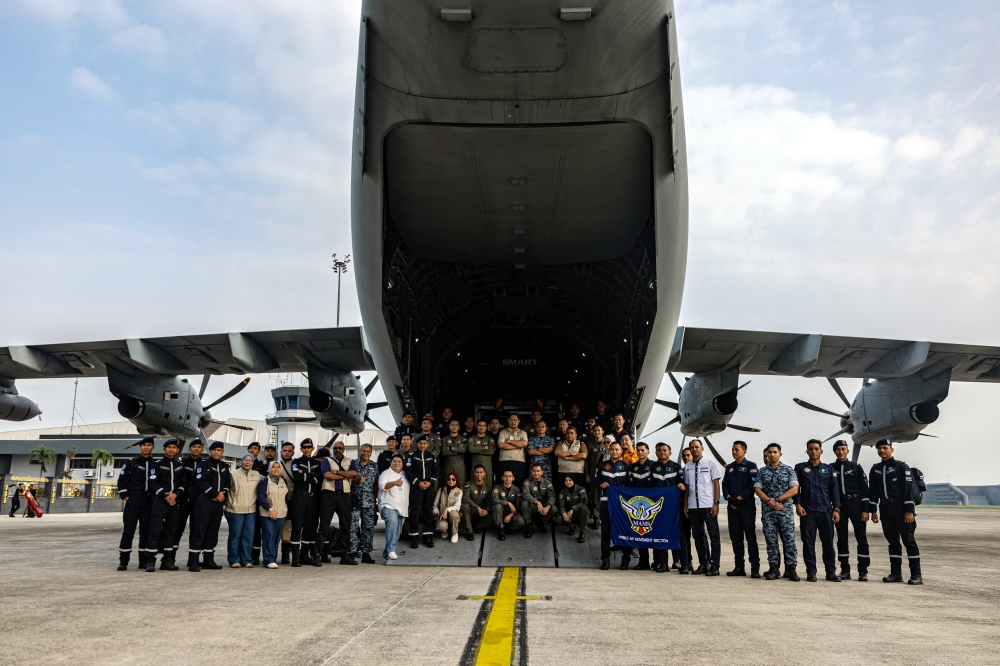
Malaysia has stepped up its humanitarian response to the devastating floods and landslides in Nepal, sending an 11-member Special Malaysian Disaster Assistance and Rescue Team (SMART) to support search and rescue operations on the ground.
The team departed for Nepal this morning aboard a Royal Malaysian Air Force (RMAF) A400M aircraft from Subang Air Base, carrying 12.4 tonnes of specialised search and rescue equipment.
The mission, coordinated by the National Disaster Management Agency (Nadma), is expected to continue for 10 days and will focus on helping those affected by the disaster, including Malaysians who remain uncontactable.
Nadma director-general Datuk Meor Ismail Meor Akim said the SMART team is led by commander Abdul Manaf Che Isa and includes personnel with specialised skills across several areas of disaster response.
The team brings together expertise in search and rescue, drone operations, logistics, communications and technical support, allowing it to respond to different challenges that may arise during the mission.
The team is expected to reach Kathmandu at about 11am local time, where Malaysian personnel will receive an operational briefing from Nepalese emergency management authorities before being deployed to designated locations.
One of the areas that could potentially receive assistance is a tunnel site, although the exact deployment location will depend on the situation assessment and briefing after the team’s arrival.
For Malaysia, the mission carries a deeply personal dimension.
Authorities are particularly focused on areas where Malaysian citizens were last reported to be. A total of 55 Malaysians remain uncontactable following the disaster on Aug 26.
At the same time, 77 Malaysians who were confirmed safe in Tibet and Nepal have already been brought to Kathmandu for processing before their return to Malaysia.
The SMART team is not arriving empty-handed.
Its cargo includes rescue equipment, detection devices, communications systems, high-capacity drones and specialised tunnel rescue equipment. A four-wheel-drive vehicle and a 10-tonne cargo truck are also being transported to support operations on the ground.
Abdul Manaf described the deployment as a humanitarian mission, stressing that the team is prepared to assist anyone requiring emergency help while maintaining particular attention on the areas involving Malaysian citizens.
The specialised equipment being brought into Nepal is expected to strengthen the team’s ability to operate in difficult and potentially hazardous environments, particularly where conventional rescue operations may not be enough.
The deployment follows an earlier decision by Prime Minister Datuk Seri Anwar Ibrahim’s government to send SMART to Nepal as part of Malaysia’s wider humanitarian response.
Malaysia is also providing US$1 million in humanitarian aid to support relief efforts following the floods and landslides.
Beyond the equipment, aircraft and personnel, the mission represents something much more human: when disaster strikes far from home, Malaysians caught in the crisis are not forgotten.
For the families still waiting for news about their loved ones, every search operation matters. Every hour matters. And the arrival of Malaysia’s SMART team in Nepal signals a determined effort to bring expertise, assistance and hope to people facing one of the region’s most difficult emergencies.
The coming days will be critical as rescue teams assess affected areas, coordinate with Nepalese authorities and work to locate those who may still be missing.
Malaysia’s response shows that humanitarian assistance is not simply about sending resources. It is about showing up when people need help most.