
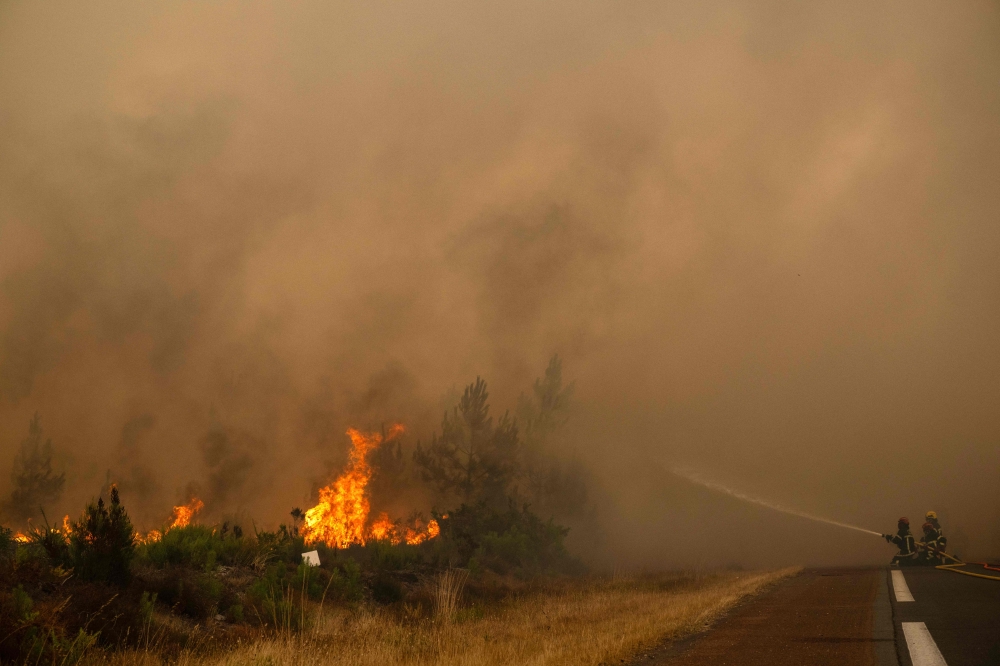
A wave of destructive wildfires sweeping across France and Spain has forced more than 300,000 people to leave their homes, holiday destinations, and communities as firefighters continue battling some of the most severe blazes seen in recent years.
Emergency shelters have become temporary homes for thousands of families as flames continue to spread through forests, residential areas, and popular tourist regions. Schools, exhibition halls, and sports facilities have been transformed into evacuation centres, offering safety to people who left behind everything they owned.
For many residents and travellers, the evacuation happened suddenly. Families packed only essential belongings as thick smoke covered the skies and flames moved dangerously close to homes.
At Bordeaux’s exhibition centre in France, thousands of displaced people spent the night on camp beds after being forced to escape the wildfire threat.
“We were told: ‘You have to evacuate,’” said Frederic Tavitian, a 70-year-old resident who described seeing massive columns of smoke rising like a volcano ready to erupt.
The emergency shelter in Bordeaux provided refuge for between 5,000 and 6,000 people as authorities worked to manage one of France’s largest peacetime evacuation operations.
Wildfires become unpredictable as firefighters face extreme conditions
Firefighters in both countries have been working around the clock as extreme heat, dry conditions, and strong winds have made the fires increasingly difficult to control.
In France’s Gironde region, firefighters warned that one wildfire created a rare “pyrocumulonimbus” cloud, a powerful fire-generated storm system capable of producing its own winds and making flames behave unpredictably.
Captain Nicolas Braz from the fire service described the situation as highly challenging, with the fire becoming difficult to manage because of rapidly changing conditions.
Spain has also faced major challenges, with evacuations ordered near Toledo, southwest of Madrid, as officials warned that weather conditions continued to increase the danger.
Spanish Interior Minister Fernando Grande-Marlaska said authorities remained concerned as temperatures and weather patterns created another difficult period for emergency teams.
Communities left heartbroken after homes are destroyed
Behind every evacuation number are thousands of personal stories of fear, uncertainty, and loss.
Some residents returned to find only ashes where their homes once stood.
“It is devastation,” said Matthieu Plessis, a 40-year-old resident of Gironde, after discovering his house had been destroyed by flames overnight.
The destruction has affected both local communities and international visitors. Tourists who arrived for holidays suddenly found themselves staying in emergency shelters instead of hotels and resorts.
Nuala Kelly, a 75-year-old Irish tourist, said she had never experienced anything like the disaster despite travelling around the world.
For families with children, the emotional impact has been especially difficult. Olivier Stewart, a French resident who evacuated with his wife and young children, said his children were the most frightened, worrying that the fire would destroy their home.
Climate change increases wildfire risks across Europe
Experts have warned that Europe’s increasing wildfire emergencies are connected to rising temperatures, prolonged droughts, and changing weather patterns.
Scientists say climate change is contributing to more frequent and intense heatwaves, creating conditions where forests and vegetation become extremely dry and vulnerable to fire.
France and Spain received support from European Union partners, including firefighting aircraft and additional resources to help control the spreading flames.
France deployed thousands of firefighters, soldiers, and emergency personnel to protect communities and slow the spread of the fires. Military aircraft were also used to drop water and fire retardant over affected areas.
Historic scale of destruction raises global concerns
The scale of the damage has reached historic levels.
Authorities reported that wildfires across France have burned tens of thousands of hectares, with some regions experiencing record levels of destruction. In southwestern France alone, vast areas of land have been consumed, destroying buildings and forcing mass evacuations.
In Spain, thousands of hectares have also been affected, with multiple fires combining and creating fears of a larger wildfire emergency near Madrid.
The disaster serves as another reminder that extreme weather events are no longer distant threats. Communities around the world are facing growing challenges from climate-related emergencies that impact homes, livelihoods, tourism, and public safety.
As firefighters continue their fight and families wait for permission to return home, the focus remains on saving lives, protecting communities, and rebuilding what has been lost.
This wildfire crisis is not just about flames and destruction. It is about people, families, and communities coming together during one of the most difficult moments of their lives.